# Covert Vulnerability Insertion
**Luigi Fiore // lypd0.com**
*May 2026*
---
## 1. Overview
Covert Vulnerability Insertion (CVI) is the practice of a threat actor deliberately embedding exploitable weaknesses into otherwise legitimate software components. Unlike conventional backdoor implants, CVI does not introduce any immediately recognisable hostile construct. There is no reverse shell, no credential stealer, no suspicious network callback. Instead, the attacker crafts a piece of code that is functionally correct under all normal operating conditions but that contains a structural defect which becomes weaponisable only when a very specifically designed payload is sent to it.
The concept is centred on a critical asymmetry: the code reviewer, the static analyser, and the functional tester all evaluate whether the code does its job correctly. It does. What none of them evaluate is whether the code is safe under adversarially crafted inputs that still appear valid at the protocol or API boundary. The attacker exploits exactly this gap.
Consider a buffer overflow that only triggers when the combined length of two fields in a network request crosses a threshold that ordinary usage never reaches. Every legitimate client sends short inputs. Every test suite uses short inputs. The server handles all of them correctly. The attacker, who designed the vulnerability, crafts a request that is perfectly valid according to the protocol specification but whose field lengths are chosen to produce a log line longer than the internal logging buffer. The server crashes, or worse, the attacker redirects execution.
The critical danger of CVI lies in the fact that it does not rely on malicious code to establish initial access. It writes perfectly acceptable code that is genuinely useful under normal circumstances, but that is weaponisable by design when conditions the attacker predetermined are met.
---
## 2. The "FileStatus" Case Study
To demonstrate CVI concretely, I developed an intentionally vulnerable client-server application called **FileStatus**. This is a small, deliberately uncomplicated program built specifically to make the technique observable in isolation. It is important to be explicit about the scope: this is a demonstrative artefact built in a few hours. A sophisticated threat actor operating in a real supply-chain context would invest considerably more effort, distributing the vulnerability across multiple modules, layering it inside refactoring commits, and calibrating it to activate only under conditions that map precisely to the target environment.
FileStatus is an example client-server application used to query metadata about files on a remote system over a custom binary protocol.
If you are interested, you may find the code of FileStatus Server & Client on my [GitHub](https://github.com/lypd0/filestatus_vulnerable_code_cvi).
### 2.1 Application Design and Thought Process
The application was deliberately designed around a pattern that is extremely common in real-world software: a network-facing component that validates inputs at the entry point and then passes them through to downstream subsystems. The downstream subsystems, in this case the audit logger, are written independently and make their own assumptions about the data they receive. This disconnect between entry-point validation and downstream assumption is precisely the attack surface CVI targets.
The Python client provides a clean command-line interface:
```
usage: client.py [-h] [--unit {bytes,kb,mb,gb}] [-v]
host port {exists,size,extension,all,custom} directory filename
client.py: error: the following arguments are required: host, port, operation, directory, filename
```
#### Normal Program Usage
The screenshot below shows the server started on port 9001 (left) and the client being used to query file existence and file size on the right. Both operations succeed and return clean JSON responses.
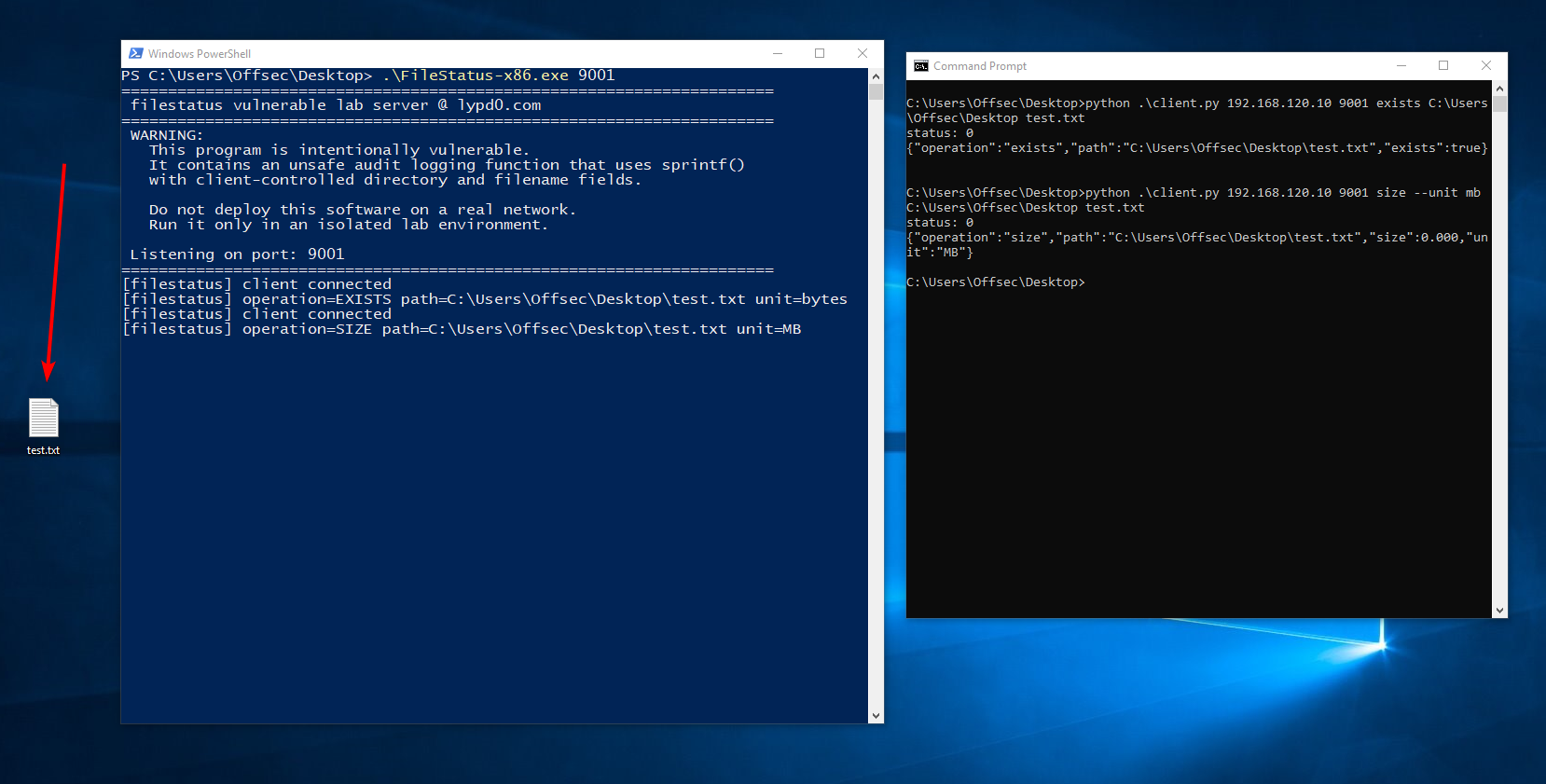
The client for a simple size query:

#### Verbose Protocol Inspection
The client supports a `-v` flag that produces a full hexdump of the outgoing request packet alongside a decoded field listing, as well as a hexdump of the raw response header and payload. This mode was built to make the binary protocol transparent during development and is equally useful for understanding exactly what bytes cross the wire.
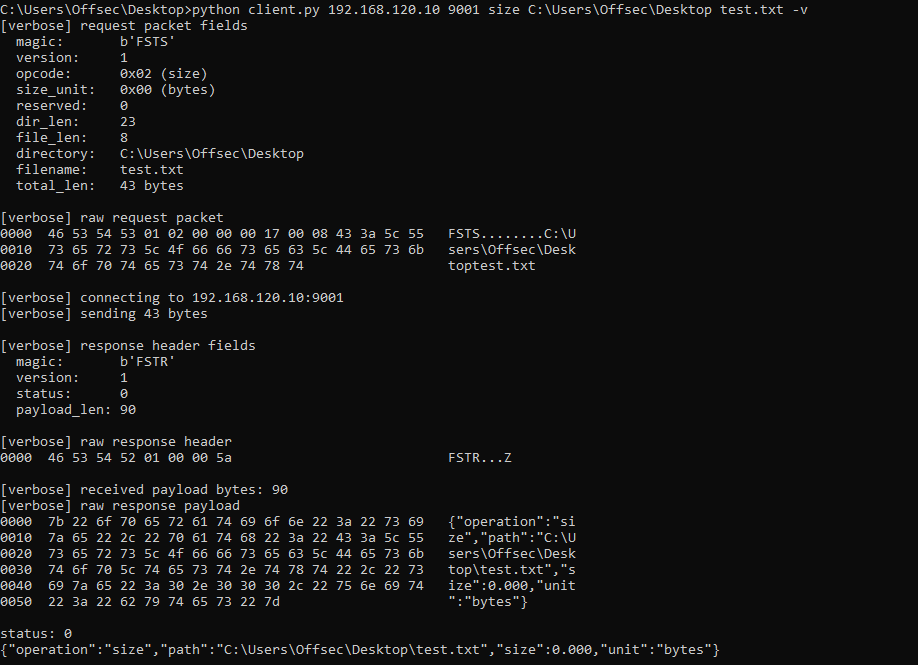
The verbose output decodes the request header fields before transmission:
```
[verbose] request packet fields
magic: b'FSTS'
version: 1
opcode: 0x02 (size)
size_unit: 0x00 (bytes)
reserved: 0
dir_len: 23
file_len: 8
directory: C:\Users\Offsec\Desktop
filename: test.txt
total_len: 43 bytes
```
The raw request packet, the connection event, the response header fields, and the full response payload hexdump all follow. This makes it immediately visible what the server receives and what it returns.
### 2.2 The Protocol
The binary protocol uses a fixed-size header followed by variable-length directory and filename fields. The header is packed and transmitted in network byte order.
```c
// Request header layout (packed, network byte order)
typedef struct {
char magic[4]; // 'F','S','T','S'
uint8_t version; // must be 1
uint8_t opcode; // EXISTS=0x01 SIZE=0x02 EXTENSION=0x03 ALL=0x04
uint8_t size_unit; // BYTES=0x00 KB=0x01 MB=0x02 GB=0x03
uint8_t reserved;
uint16_t dir_len; // max 1024 bytes
uint16_t file_len; // max 255 bytes
} RequestHeader; // followed by dir_len bytes, then file_len bytes
```
The response uses a symmetric structure: a four-byte magic `FSTR`, a version byte, a status byte, a two-byte payload length in network byte order, and a variable-length JSON payload.
**Supported opcodes:**
| Opcode | Value | Description |
|--------|-------|-------------|
| EXISTS | 0x01 | Returns whether the file is present on disk |
| SIZE | 0x02 | Returns the file size in the requested unit |
| EXTENSION | 0x03 | Extracts and returns the file extension |
| ALL | 0x04 | Returns all available metadata in a single response |
| CUSTOM | 0x10 | Placeholder for future operations |
### 2.3 Server-Side Validation
The server performs four sequential validation checks before any opcode handler runs. All four checks are correct and represent genuine defensive programming. This is intentional. The strength of the CVI technique depends on the entry-point validation being sound.
```c
// 1. Magic and version
if (memcmp(req.magic, MAGIC_REQ, 4) != 0 || req.version != PROTO_VERSION) {
send_response(client, STATUS_BAD_REQUEST, ...);
return;
}
// 2. Field length bounds
if (dir_len == 0 || file_len == 0 ||
dir_len > MAX_DIR_LEN || file_len > MAX_FILE_LEN) {
send_response(client, STATUS_BAD_REQUEST, ...);
return;
}
// 3. Filename safety (no traversal, no separators)
if (strstr(filename, "..") != NULL ||
strchr(filename, '/') != NULL ||
strchr(filename, '\\') != NULL) {
send_response(client, STATUS_BAD_REQUEST, ...);
return;
}
// 4. Path construction via bounded snprintf (safe)
join_path(fullpath, sizeof(fullpath), directory, filename);
```
An auditor reviewing this parser would correctly conclude that it handles path traversal, oversized fields, and protocol malformation. That conclusion is accurate. The vulnerability is not here.
---
## 3. The Vulnerability
### 3.1 Location and Nature
The CVI payload in FileStatus is a **stack-based buffer overflow** in the audit logging function `log_file_query_unsafe()`. This function is called *after* all validation and *after* all safety-critical path operations have completed. Its only purpose is to write a human-readable log line recording what operation was performed. This is the exact kind of feature that developers add without treating as a security boundary, because "it is just logging."
```c
/*
* INTENTIONALLY VULNERABLE LOGGER.
*
* Purpose: produce a normal audit log entry for every file query.
*
* Vulnerability: the log line is written into a fixed-size stack buffer
* with sprintf(). The directory and filename are client-controlled protocol
* fields. They may be valid for the protocol but too long for this buffer.
*/
static void log_file_query_unsafe(
const char *operation,
const char *directory,
const char *filename,
uint8_t size_unit
) {
char logline[128]; // <-- fixed-size stack buffer
#ifdef _WIN32
sprintf( // <-- no bounds argument: UNSAFE
logline,
"[filestatus] operation=%s path=%s\\%s unit=%s",
operation,
directory,
filename,
unit_name(size_unit)
);
#else
sprintf(
logline,
"[filestatus] operation=%s path=%s/%s unit=%s",
operation,
directory,
filename,
unit_name(size_unit)
);
#endif
puts(logline);
}
```
`sprintf()` receives a pointer to `logline` but not its size. It writes the complete formatted string into the buffer regardless of how long that string is. The dangerous data is `directory` and `filename`, both of which come directly from the client packet.
### 3.2 The Context Mismatch
The protocol enforces:
```
directory length <= 1024 bytes
filename length <= 255 bytes
```
The logger enforces nothing. It silently assumes:
```
complete log line < 128 bytes
```
Both constraints cannot hold simultaneously for all valid inputs. A filename of 100 bytes combined with a short directory already produces a log line of approximately 140 bytes, exceeding the 128-byte buffer by 12 bytes. The protocol allows filenames up to 255 bytes, giving the attacker ample room.
The approximate structure of the log line:
```
"[filestatus] operation=" = 23 bytes (constant)
<operation name> = 3-9 bytes (e.g. "SIZE" = 4)
" path=" = 6 bytes (constant)
<directory> = 1-1024 bytes <-- attacker-controlled
"/" or "\\" = 1 byte (separator)
<filename> = 1-255 bytes <-- attacker-controlled
" unit=" = 6 bytes (constant)
<unit name> = 2-7 bytes (e.g. "MB" = 2)
null terminator = 1 byte
minimum total: ~43 bytes (safe)
maximum total: ~1328 bytes (overflows 128-byte buffer by 1200 bytes)
```
**Important lesson:** input can be valid for the protocol and still unsafe for a later internal buffer. The parser checks `dir_len <= MAX_DIR_LEN` and `file_len <= MAX_FILE_LEN`, and those checks are correct for the protocol. They do not guarantee that `directory + filename + log formatting` fits inside `logline[128]`.
### 3.3 Step-by-Step Vulnerable Execution
The following trace shows how a single valid protocol request traverses the server and triggers the overflow:
```
[ handle_client() ]
1. recv_all() reads the 12-byte RequestHeader.
2. magic == 'FSTS' and version == 1 => pass.
3. dir_len=7 and file_len=200 => both within protocol limits => pass.
4. recv_all() reads directory (e.g. "C:\Temp").
5. recv_all() reads filename (200-byte crafted string).
6. filename contains no '..' '/' '\\' => traversal check passes.
7. join_path() builds fullpath with snprintf() => safe.
8. opcode == OPCODE_SIZE => dispatch to handle_size_request().
[ handle_size_request() ]
9. is_regular_file() calls stat() on fullpath.
10. File exists and is a regular file => proceed.
11. log_file_query_unsafe("SIZE", directory, filename, size_unit) <-- TRIGGER
[ log_file_query_unsafe() ]
12. char logline[128] allocated on the stack.
13. sprintf(logline, "...", "SIZE", "C:\Temp", <200-byte filename>, "MB")
formatted output is ~242 bytes.
14. sprintf writes 242 bytes into 128-byte buffer.
bytes 128-241 overwrite adjacent stack memory.
15. Stack corruption: saved return address, frame pointer, or canary overwritten.
16. On return: crash (DoS) or controlled EIP/RIP redirection (RCE).
```
### 3.4 Demonstrating the Overflow
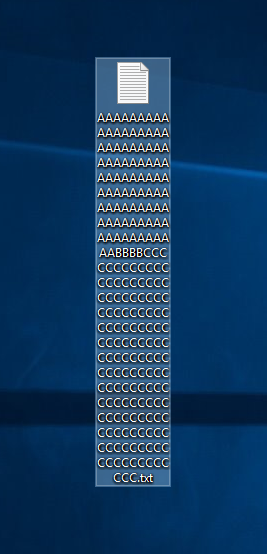
To trigger the vulnerability, a file is created on the target system whose name is long enough to exceed the logging buffer when combined with the directory and operation fields. The filename consists of a block of `A` characters followed by `B` characters to find the EIP offset, then `C` characters as a recognisable pattern in the overflow region.
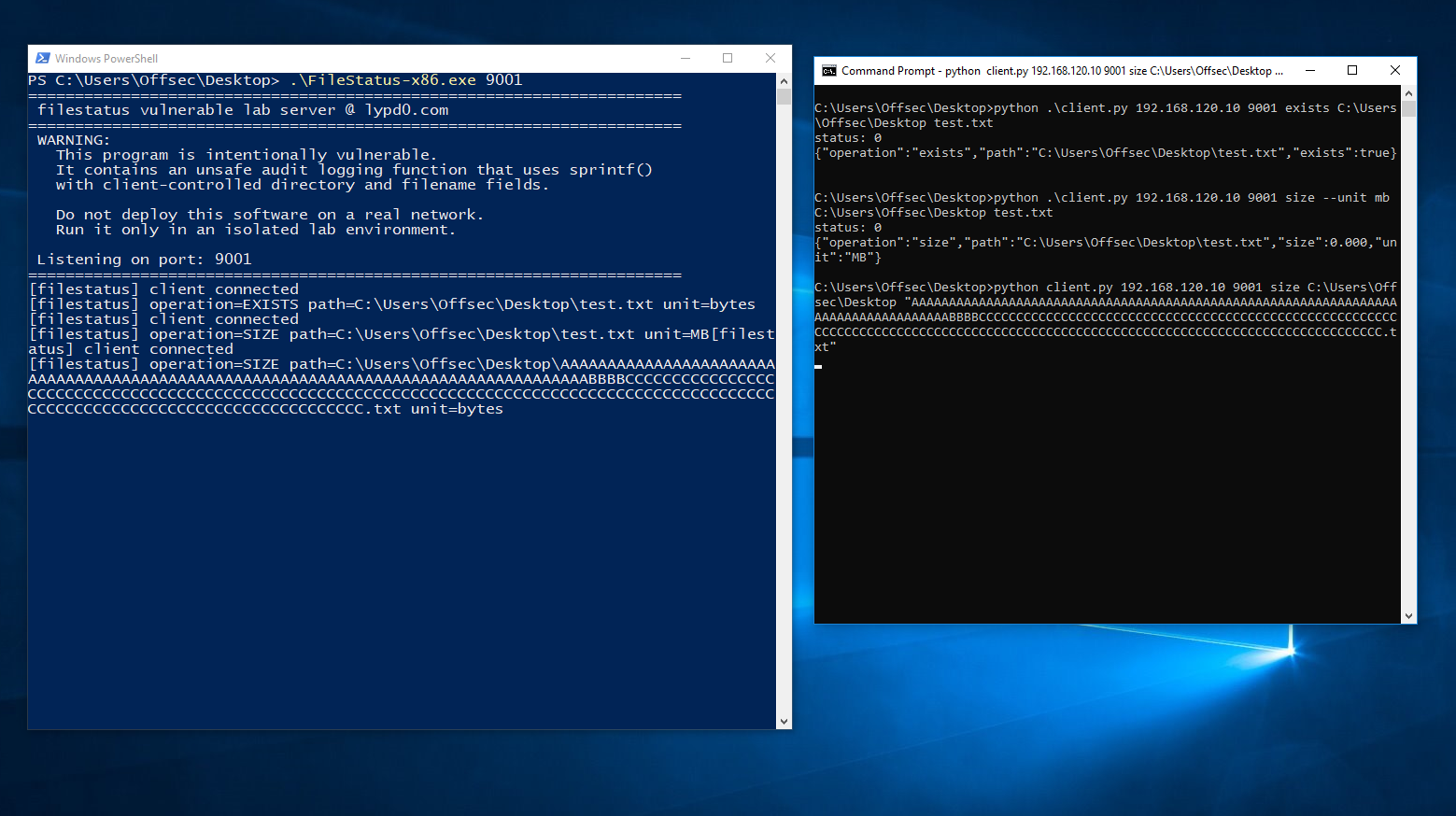
The server is started and the client sends a `size` request for that file. The server processes the request, passes all validation, and crashes inside the logger.
The crash is an access violation triggered by EIP being overwritten with `0x42424242` (four `B` bytes), confirming the offset calculation and demonstrating controlled instruction pointer redirection:
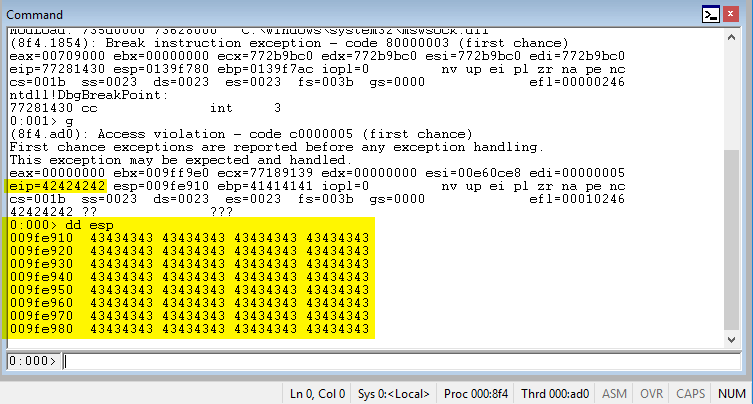
The WinDbg output is unambiguous:
```
(8f4.ad0): Access violation - code c0000005 (first chance)
eip=42424242 ebp=41414141 iopl=0
cs=001b ss=0023 ds=0023 es=0023 fs=003b gs=0000
0:000> dd esp
009fe910 43434343 43434343 43434343 43434343
009fe920 43434343 43434343 43434343 43434343
009fe930 43434343 43434343 43434343 43434343
...
```
EIP is fully controlled at `0x42424242`. The stack is filled with `0x43` bytes (`C`). This confirms that the overflow is reliable and that an attacker who replaces the `B` block with the address of a ROP gadget or shellcode can redirect execution arbitrarily.
### 3.5 The Safe Reference Implementation
The server source includes a safe version of the logging function that is not called in the intentionally vulnerable build. The difference is a single substitution:
```c
static void log_file_query_safe(
const char *operation,
const char *directory,
const char *filename,
uint8_t size_unit
) {
char logline[128];
int written = snprintf( // <-- bounds-aware
logline,
sizeof(logline), // <-- destination size passed explicitly
"[filestatus] operation=%s path=%s/%s unit=%s",
operation,
directory,
filename,
unit_name(size_unit)
);
if (written < 0) {
puts("[filestatus] failed to format log line");
return;
}
if (written >= (int)sizeof(logline)) {
puts("[filestatus] log line truncated");
return;
}
puts(logline);
}
```
`snprintf()` receives `sizeof(logline)` as its second argument. It will never write more than 128 bytes into the buffer. The return value is checked for both formatting errors and truncation. The function is functionally identical for short inputs; the only difference is that it does not corrupt the stack for long ones.
---
## 4. Why CVI is Dangerous
### 4.1 It Passes Code Review
Standard code review is optimised to identify constructs that are immediately hostile: hardcoded credentials, shell execution, suspicious network callbacks, obvious injection points. A logging function that uses `sprintf()` does not produce any of those signals. A reviewer assessing `log_file_query_unsafe()` would see a function that generates a log entry and calls `puts()`. Without explicitly calculating whether the combined length of all log fields can overflow a 128-byte buffer, the review produces no finding.
### 4.2 It Bypasses Static Analysis
SAST tools flag known-dangerous function calls such as `sprintf()`, `strcpy()`, and `gets()`. However, their value is limited when the overflow depends on the combined runtime length of two independently valid fields. Most tools require a statically provable bounds violation. When the violation depends on variables that are each within their individual bounds but together exceed a third bound, most tools produce no alert. More sophisticated taint-tracking tools (CodeQL, Coverity) can catch this, but only when the analysis follows data flow across function boundaries from the protocol parser all the way to the logger.
### 4.3 It Survives Functional Testing
Test suites use inputs representative of normal usage. A test suite for FileStatus would verify that `exists`, `size`, `extension`, and `all` return correct results for valid files, that bad magic values are rejected, that path traversal sequences are blocked. None of those tests produce a filename long enough to overflow the logging buffer. The vulnerability is dormant during all testing.
### 4.4 It Does Not Require Malicious Code
The attacker does not insert a backdoor, a shell, or any hostile primitive. They insert a logging call that uses `sprintf()`. Every component of that code is legitimate, useful, and standard practice in C. The weaponisability is not in the code; it is in the knowledge of the gap between what the protocol accepts and what the logger can handle.
### 4.5 CVI Extends Beyond Memory-Unsafe Languages
While the FileStatus example uses a buffer overflow in C, CVI is language-agnostic. The same principle applies wherever a gap exists between what one layer validates and what a downstream layer assumes. In memory-safe languages the overflow class disappears, but the concept survives:
- **Unsafe deserialization:** a planted custom type handler that activates on a specific class name embedded in attacker-controlled data.
- **Prototype pollution:** a deliberately unguarded deep-merge function in JavaScript that processes `__proto__` keys normally absent from legitimate inputs.
- **Timing oracles:** a subtly non-constant-time comparison in an authentication routine that is only exploitable by an attacker with network measurement capability.
- **SSRF via configuration:** an HTTP client initialiser that omits private IP range restrictions, triggering only when an attacker supplies a URL pointing to a cloud metadata endpoint.
- **Path traversal via partial sanitisation:** a filename sanitiser that handles standard traversal sequences but misses URL-encoded or Unicode-normalised variants that never appear in legitimate requests.
In every case the structure is the same: legitimate-looking code, correct behaviour under normal inputs, exploitable gap under adversarially crafted inputs that still pass the outermost validation layer.
---
## 5. Conclusion
Covert Vulnerability Insertion is qualitatively different from conventional malware insertion. By embedding an exploitable defect rather than an explicitly hostile payload, the attacker produces code that is genuinely functional, passes the majority of automated and manual security checks, and provides no direct signal of malicious intent. The vulnerability exists only in the gap between what one part of the program validates and what another part assumes.
The FileStatus case study makes this concrete. The parser is correctly implemented. The path construction is safe. The individual protocol constraints on directory and filename lengths are reasonable. The vulnerability exists only because the logging function applies a different, smaller, and unenforced constraint to the same data. An attacker who understands this gap can trigger the overflow with a perfectly valid protocol request. A reviewer examining only the parser finds nothing.
Defending against CVI requires abandoning the assumption that validation at one layer confers safety at all subsequent layers. Each function that processes data must independently enforce the invariants it requires. Compiler hardening, runtime instrumentation, coverage-guided fuzzing, and differential dependency review all contribute to a layered defence that reduces both the probability of successful insertion and the probability of successful exploitation if an insertion reaches production.
As software supply chains grow more complex and AI-assisted development introduces new code provenance challenges, the CVI threat will become more relevant, not less.
---
## Appendix: FileStatus Protocol Reference
### Request Header
```
Offset Size Field Description
------ ---- --------- --------------------------------------------------
0 4 magic "FSTS" (0x46 0x53 0x54 0x53)
4 1 version Protocol version, must be 0x01
5 1 opcode Operation code (see table below)
6 1 size_unit 0x00=bytes 0x01=KB 0x02=MB 0x03=GB
7 1 reserved Must be 0x00
8 2 dir_len Directory length in bytes, network byte order, max 1024
10 2 file_len Filename length in bytes, network byte order, max 255
12 - directory dir_len bytes, UTF-8, no null terminator in wire format
12+D - filename file_len bytes, UTF-8, no path separators, no ".."
```
### Response Header
```
Offset Size Field Description
------ ---- ---------- --------------------------------------------------
0 4 magic "FSTR" (0x46 0x53 0x54 0x52)
4 1 version Protocol version, echoes request
5 1 status 0x00=OK 0x01=BAD_REQUEST 0x02=NOT_FOUND
0x03=STAT_FAILED 0x04=UNKNOWN_OPCODE
6 2 payload_len JSON payload length in bytes, network byte order
8 - payload UTF-8 JSON, length given by payload_len
```
### Status Codes
| Code | Value | Meaning |
|------|-------|---------|
| STATUS_OK | 0x00 | Request processed successfully |
| STATUS_BAD_REQUEST | 0x01 | Malformed header, invalid lengths, or traversal detected |
| STATUS_NOT_FOUND | 0x02 | The specified file does not exist |
| STATUS_STAT_FAILED | 0x03 | The path exists but is not a regular file |
| STATUS_UNKNOWN_OPCODE | 0x04 | The opcode field contains an unrecognised value |